
The Wimbledon venue is the All England Lawn Tennis and Croquet Club (AELTC), located at Church Road, Wimbledon, London SW19 5AE. The total capacity across all courts is over 42,000 spectators daily. Centre Court holds 14,979. The nearest tube station is Southfields (District Line) — a 15-minute walk. The venue hosts the 139th Championships from June 29 – July 12, 2026.
Court
1
2
Courts
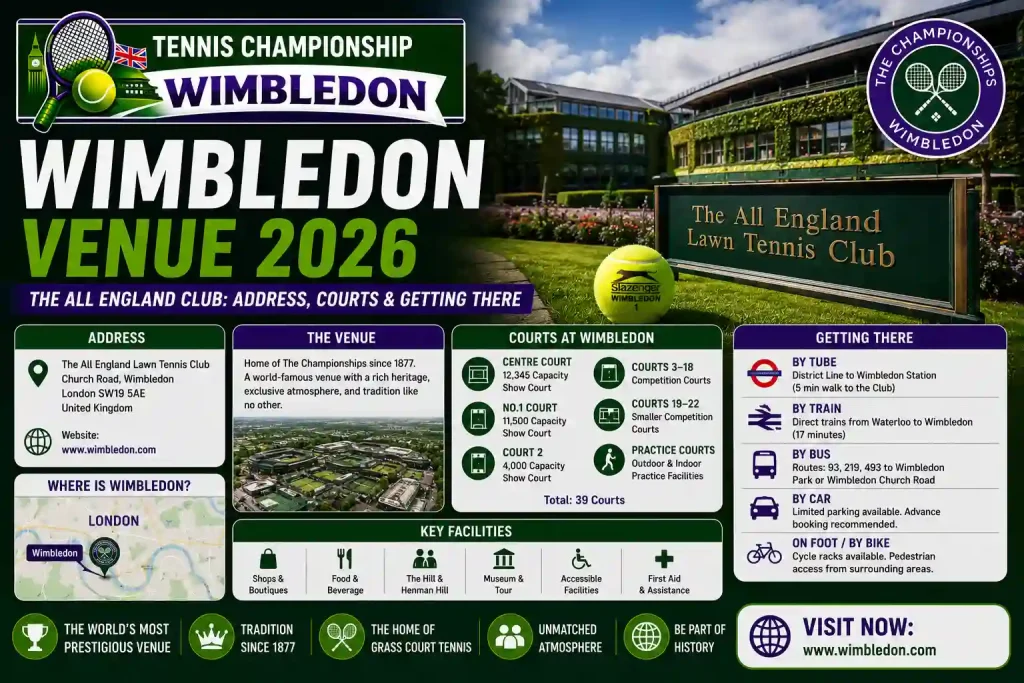
Wimbledon Venue 2026 — The All England Club: Address, Courts & Getting There
The Wimbledon tennis venue is one of the most famous sporting addresses on earth. Whether you’re asking what is the Wimbledon venue called, looking for the exact address and postcode, the capacity, a venue map, or how to get there by tube and train — this complete guide covers everything you need to know about the All England Club for the 2026 Championships.

What Is the Wimbledon Venue Called?
The official name of the Wimbledon tennis venue is the All England Lawn Tennis and Croquet Club — commonly abbreviated to the All England Club or AELTC. This is where the Championships have been held every year since 1877.
Despite being known globally as “Wimbledon,” the club itself is not in the centre of Wimbledon town — it sits on Church Road in the SW19 postcode of south-west London, in the neighbourhood of Wimbledon. The venue’s full name retains “Croquet” because the club was originally founded as a croquet club — lawn tennis was only added to its activities (and its name) when the sport swept Victorian England in the 1870s.
Wimbledon Venue Address & Postcode
Here is the official Wimbledon venue address for all correspondence, navigation and ticket purposes.
SW19 5AG or SW19 5AF for navigation — the official SW19 5AE postcode covers a large area and may direct you to the wrong gate.Wimbledon Venue — Country & Location
The Wimbledon venue country is England (United Kingdom). More specifically, the All England Club is located in the London Borough of Merton, in south-west London — approximately 7 miles (11 km) south-west of central London.
Wimbledon Venue Capacity — All Courts
The Wimbledon venue capacity varies significantly between courts. The total daily attendance across the entire grounds exceeds 42,000 spectators — making Wimbledon one of the highest daily-capacity Grand Slam events.
| Court | Capacity | Roof | Surface | Primary Use |
|---|---|---|---|---|
| Centre Court | 14,979 | ✅ Retractable (2009) | Grass | All finals · Top seeds · Semis |
| No. 1 Court | 12,345 | ✅ Retractable (2019) | Grass | Quarterfinals · High-profile matches |
| No. 2 Court | 4,000 | ❌ Open air | Grass | Show court · “Graveyard of Champions” |
| No. 3 Court | 2,000 | ❌ Open air | Grass | Show court · Doubles · Early rounds |
| Courts 4–18 | 200–1,000 each | ❌ Open air | Grass | Outer courts · Early rounds |
| Total Daily Capacity | 42,000+ | All courts combined including standing and grounds pass areas | ||
Centre Court Wimbledon — Full Guide
Centre Court is the heart of the Wimbledon venue — the most famous tennis court in the world. Every Wimbledon final has been played here since the venue moved to Church Road in 1922.
What Makes Centre Court Special?
No other tennis court carries the same weight of history, atmosphere or tradition as Centre Court. Three things set it apart from any other venue in sport:
- No advertising: Centre Court is one of the last major sporting venues on earth without a single commercial hoarding or sponsorship banner. The only colours are the green of the grass and the white of the players.
- The Kipling inscription: Every player entering Centre Court through the players’ entrance passes under a wooden inscription of Rudyard Kipling’s famous lines from If— — one of tennis’s most powerful pre-match moments.
- The Royal Box: The formally dressed Royal Box on the south side of Centre Court has hosted every British monarch since King George V in 1907. Bowing and curtsying when the Royal Family attends is a tradition maintained to this day.
- The silence: Wimbledon crowds observe genuine silence during points — a rarity in world sport. The atmosphere between points is electric; during them, almost eerily quiet.
Wimbledon Venue Map
The Wimbledon venue map shows the layout of the All England Club grounds, which span 42 acres across the Church Road site. Here is a schematic guide to the key areas, courts and gates.
Court
Gate 4
4–7
8–11
12–18
For the official interactive venue map with accessible routes, food courts and facilities, visit wimbledon.com/venue-guide. The official printed map is available free at all gates on arrival.
All 18 Wimbledon Courts — Complete Guide
The All England Club has 18 Championship grass courts in addition to 20 practice grass courts, 8 clay courts, 2 acrylic courts and 5 indoor courts. Here is the complete guide to the courts used during the Championships.
The home of every Wimbledon final since 1922. No advertising. The Royal Box. The Kipling inscription. Reserved exclusively for the most prestigious matches and all finals. Tickets are the hardest to obtain in tennis.
The second show court — rebuilt in 1997 at a cost of £70m. Hosts quarterfinals, high-profile seeded matches and the most important matches not on Centre Court. Its 2019 renovation added a roof, cushioned seating and dramatically improved sight lines.
The original “Graveyard of Champions” — more top seeds have been knocked out here than on any other court. The nickname came from a previous No. 2 Court and has stuck despite the rebuild. Outer courts fans consider it the best value ticket at Wimbledon for match quality per pound.
Rebuilt in 2011. An intimate show court with good viewing angles. Popular with outer-court enthusiasts. Often features exciting doubles and mixed doubles matches in the second week.
Fourteen outer courts where the atmosphere of Wimbledon is at its most intimate. You can sit within 5–10 metres of world top-100 players during the first week. Courts 12 and 18 are the most popular outer courts among regular attendees. Court 18 is where the legendary Isner-Mahut match was played in 2010.
Getting to the Wimbledon Venue — Travel Guide
Over 42,000 spectators travel to the All England Club each day of the Championships. The AELTC strongly recommends public transport — car parking is severely limited and requires pre-booking.
From Earl’s Court, trains run to Southfields every 5–8 minutes throughout the tournament day. All three stations have step-free access.
Wimbledon Station is a major interchange with District Line, South Western Railway and Tramlink — the most flexible arrival point.
Driving is discouraged. Traffic congestion during the Championships is severe. Public transport is strongly recommended by the AELTC.
Key Distances from the Wimbledon Venue
| Location | Distance | Travel Time (Approx.) | Best Method |
|---|---|---|---|
| Southfields Tube | 0.9 miles | 15 min walk | District Line → walk |
| Wimbledon Station | 1.2 miles | 20 min walk or 8 min shuttle | Train or Tube + shuttle |
| Wimbledon Park Tube | 1.4 miles | 25 min walk | District Line → walk |
| Central London | 7 miles | 35–45 min | Tube (District Line) |
| Heathrow Airport | 12 miles | 55–65 min | Piccadilly + District |
| Gatwick Airport | 26 miles | 60–75 min | Gatwick Express + SWR |
Wimbledon Qualifying Venue
The Wimbledon qualifying venue is a separate site from the All England Club — an important distinction many fans don’t know. Qualifying matches are held at a different location and are open to the public for free.
- Located approximately 3 miles north-west of the All England Club in Roehampton, SW15
- Free admission for spectators — no ticket required, no reservation needed
- Features 22 grass courts used for qualifying play
- Men’s and women’s qualifying each run 3 rounds over 4 days
- Nearest station: Barnes (South Western Railway) or bus from Richmond
- One of tennis’s best-kept secrets — see future stars up close for nothing
Wimbledon Venue Tickets — How to Get In
There are four routes to securing Wimbledon venue tickets for the 2026 Championships. The method you use determines both the type of access and the price you’ll pay.
The annual public ballot run by the AELTC gives face-value access to all courts. Results emailed in January. One of the best-value routes when you get through — Centre Court tickets from ~£85.
Turn up at Wimbledon Park from the previous evening. Grounds Pass from £33. Around 500 show court tickets also available each day via The Queue. The most iconic way to attend Wimbledon.
The only legal ticket resale market. Centre Court debenture seats from ~£2,195 per ticket. The only route for guaranteed Centre Court access — particularly for finals (from ~£7,000+).
Official partners Keith Prowse and Sportsbreaks.com offer packages from ~£1,025 per person including guaranteed match tickets, dining and transfers.
For the complete ticket guide including prices, the Queue rules and debenture details, see our Wimbledon championship tickets page.
Venue History — From Worple Road to Church Road
The Wimbledon tennis venue has had two homes in its 149-year history. Understanding how the venue moved helps explain the unique character of the current grounds.
The first Championships were held in the grounds of the All England Croquet Club on Worple Road, Wimbledon — a modest site that could accommodate around 3,000 spectators by 1900. The 1877 final was watched by approximately 200 people who paid one shilling each. By the early 1900s, Wimbledon’s global fame had made the original grounds hopelessly small.
The AELTC purchased land on Church Road in 1920 and moved the Championships there in 1922. King George V attended the opening. The new Centre Court was purpose-built with a capacity of 9,989 — since expanded to nearly 15,000. The name “Centre Court” was carried over from the Worple Road venue, even though it is no longer geometrically in the centre of the grounds.
On 11 October 1940, a German bomb destroyed 1,200 seats in Centre Court. The tournament was suspended throughout WWII. The court resumed hosting Wimbledon in 1946, with the bomb damage not fully repaired until 1947. A reminder that even the most iconic venues carry the scars of history.
After decades of rain delays, a £100 million retractable roof was installed over Centre Court — the most significant structural change to the venue since 1922. It was first used in action during the 2009 Championships. Court 1 received its own roof in 2019, making two of Wimbledon’s courts weather-proof.
In 2021, the AELTC announced a major long-term expansion plan, having acquired the former Wimbledon Park Golf Club site for £65 million in 2018. Plans include 38 additional practice courts, an 8,000-seat new stadium and the eventual possibility of moving qualifying from Roehampton to the main site — transforming SW19 into one of the world’s great sporting campuses.
Wimbledon Venue — At a Glance
Championship
Grounds
Courts
Capacity
Attendance
(Retractable roofs)
📝 Summary
The Wimbledon venue is the All England Lawn Tennis and Croquet Club (AELTC), located at Church Road, Wimbledon, London SW19 5AE, in England, UK. The grounds span 42 acres and contain 18 Championship grass courts. Centre Court — the Wimbledon final venue — holds 14,979 spectators and has had a retractable roof since 2009. No. 1 Court (12,345 seats) received its roof in 2019. Total daily capacity across the grounds exceeds 42,000. The nearest tube station is Southfields (District Line), a 15-minute walk. For the 2026 Championships (June 29 – July 12), tickets are available via The Queue (Grounds Pass from £33), debenture resale, or official hospitality packages. The Wimbledon qualifying venue is a separate site: Wimbledon Community Sport Centre, Roehampton SW15, where qualifying runs June 22–25 and is free to the public.